
What is the ICCL?
The Reading Comprehension Coefficient Index (ICCL) is an assessment that measures how well a person's reading fluency matches their ability to take in and understand the key concepts of a text from their field of knowledge. The result is a number between 0 and 2 that places the reader in one of three levels of comprehension.
Its purpose is to provide an objective indicator of reading performance so that students and teachers can spot areas for improvement and apply personalized strategies.
How it is given
- Reading aloud (1 minute). The student reads a text from their field and marks the last word they reached.
- Silent reading (1 minute). They read the same text again, silently, and mark again.
- Concept integration (up to 15 minutes). They define in their own words 30 concepts taken from the text.
Texts are chosen according to education level (basic for elementary and middle school, intermediate for high school and bachelor's, advanced for master's and doctorate) and field of knowledge.
How it is calculated
- L.D. and L.S.: reading aloud and silent reading
- Words read in one minute in each phase.
- P.L.F.: final reading average
P.L.F. = (L.D. + L.S.) ÷ 2
- P.P.P.M.: percentage of words per minute
P.P.P.M. = P.L.F. × 100 ÷ 300
A reading speed of 300 words per minute is used as the reference.- P.I.E.M. and P.P.I.: words incorporated
- Concepts defined correctly and their percentage of the total.
P.P.I. = P.I.E.M. × 100 ÷ total concepts
- I.C.C.L.: Reading Comprehension Coefficient Index
I.C.C.L. = P.L.F. ÷ 300 + P.I.E.M. ÷ total concepts
It adds fluency (up to 1) and concept integration (up to 1), which is why it ranges from 0 to 2.- P.I.C.L.: percentage of the index
P.I.C.L. = I.C.C.L. × 100 ÷ 2
The three levels of comprehension
Preconceptual (ICCL below 0.8)
This is the initial level of knowledge, where the person makes a first cognitive contact with the objects or phenomena of the world. Sensory perceptions, immediate associations and concrete experiences predominate.
Example: a student recognizes elements of the text (characters, colors, simple actions) but does not understand their meaning beyond what is visible or literal.
Conceptual (ICCL from 0.8 to 1.5)
The capacity for abstraction becomes established. The person can separate specific properties of an object and group them, forming mental concepts. Logical-formal thinking emerges, able to organize information coherently.
Example: a student not only identifies but begins to interpret the content, infer implicit meanings and establish relationships between ideas in the text.
Categorical (ICCL of 1.5 or more)
Higher level of epistemic thinking: the person organizes knowledge into broad, hierarchical systems, integrates multiple concepts and links them to global explanations, hypotheses, theories and principles.
Example: a student critically analyzes the text, compares it with others, identifies deep structures and is able to draw general principles, theorize or propose new interpretations.
Who it is for
For students in elementary school, middle school, high school, bachelor's, master's and doctoral programs, and for teachers who want to know their group's level. There are readings in ten fields: experimental sciences, humanities, social and cultural sciences, engineering and technology, economics and management, arts and design, medicine, nursing, mathematics and literature (classics and popular books).
Information card
The card brings together the purpose, the step-by-step administration, the interpretation of the algorithm, the background and the suggested strategies to strengthen the ICCL (in Spanish).
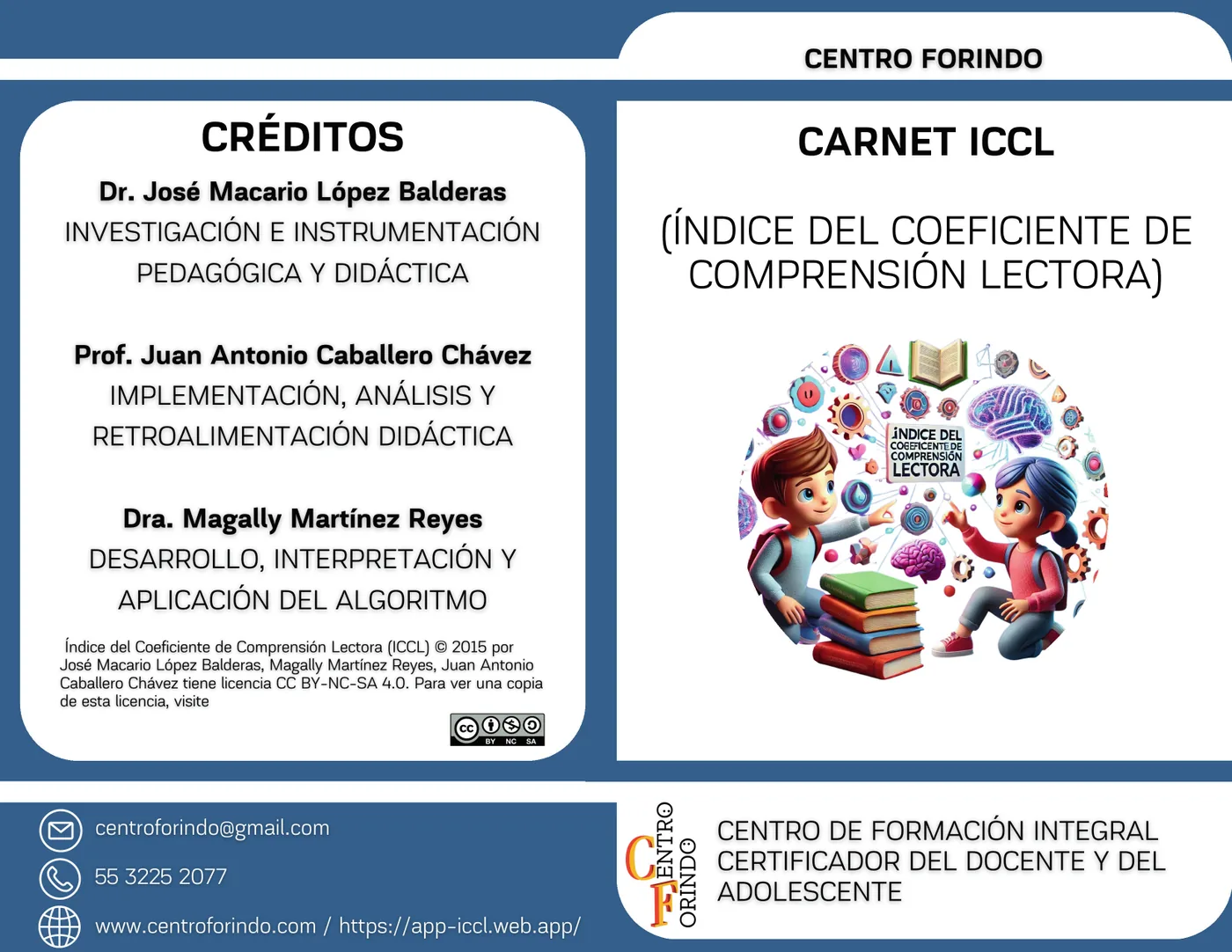
1 of 9 · Swipe or use the arrows to browse it (in Spanish)
Frequently asked questions
How much does it cost?
Nothing: the ICCL assessment is free. If you need a deeper, more complete analysis (for example, for a group, a school or an institution), a professional version of the ICCL, more powerful and with more features, is coming soon. Write to us at centroforindo@gmail.com to find out more.
How long does it take?
About 20 minutes: two one-minute readings and up to 15 minutes to define the concepts.
What do I need?
A computer, tablet or phone with internet access and a place where you can read aloud.
Can I take it again?
Yes. Enter your ICCL code in each assessment and you will see your progress in My results. You can also look yourself up in the ranking.
What happens to my data?
Your email and your institution are confidential. The public ranking only shows your first name with the initials of your last names, your country, state, grade, field and score. Everything is explained in the privacy notice.
Authors and license
The ICCL methodology, algorithm and content are the work of Dr. José Macario López Balderas, Dr. Magally Martínez Reyes and Prof. Juan Antonio Caballero Chávez, of Centro Forindo. The ICCL © 2015 is licensed under CC BY-NC-SA 4.0: you may share and adapt it for non-commercial purposes, crediting the authors and under the same license (details in the terms and conditions).